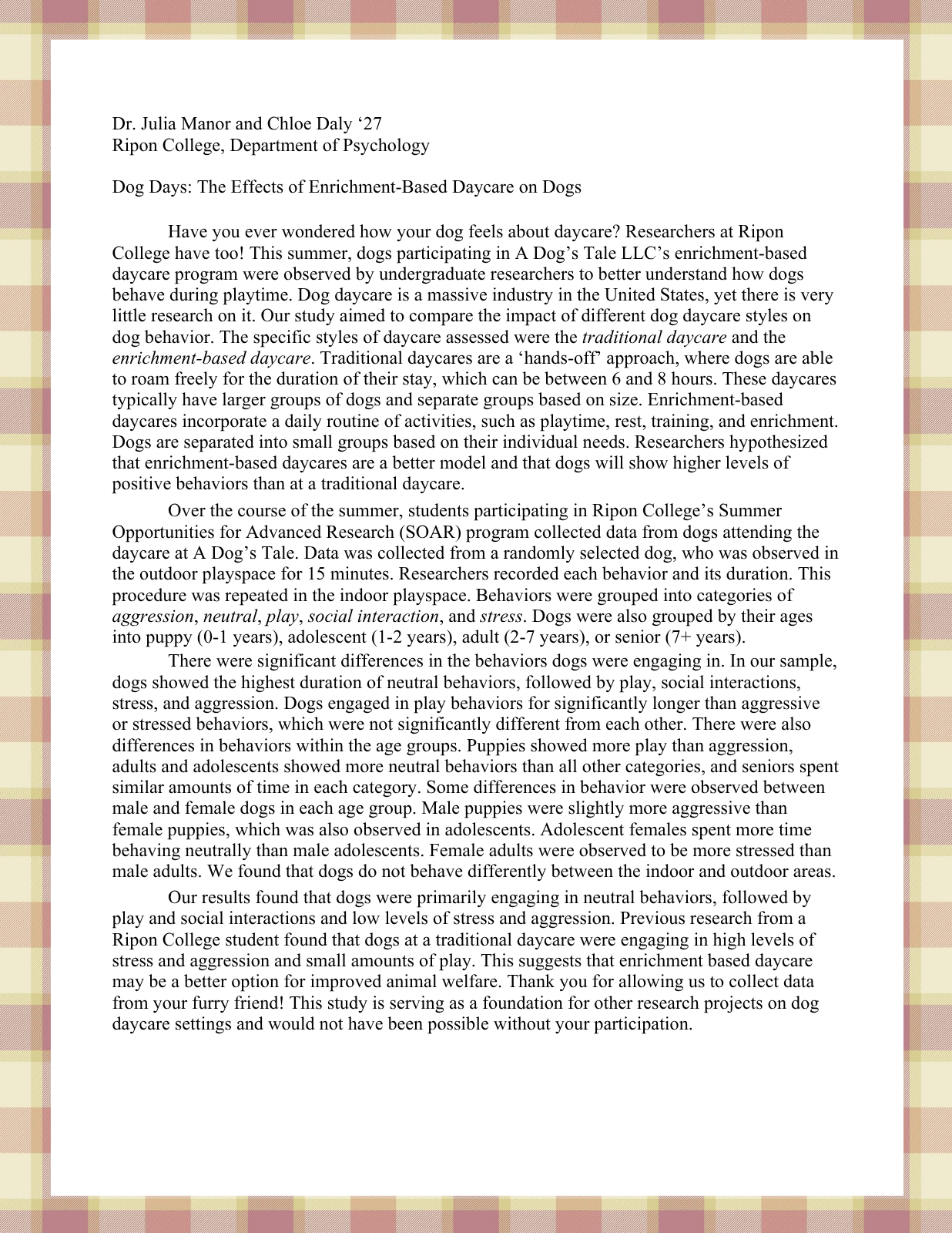
A little about the research
We collected behavioral data from 31 dogs attending enrichment-based daycare at A Dog’s Tale and compared our findings with previously collected data from 30 dogs attending a traditional daycare. Using 15-minute behavioral observations, researchers examined behaviors such as play, relaxation, human interaction, sniffing, barking, growling, and other potential indicators of stress or aggression. We also looked at differences between indoor and outdoor play areas, age groups, and sexes.
What did we find?
One of the most encouraging findings was that, compared with the traditional daycare model, dogs in our enrichment-based model demonstrated similar amounts of play, but lower levels of aggression and stress-related behaviors. This is an important step in understanding how daycare structure and practices may influence dogs’ experiences.
We also found that:
Dogs spent most of their observed time engaging in neutral behaviors, such as relaxing, resting, or wandering.
Dogs behaved similarly in indoor and outdoor play areas.
Male and female dogs showed similar overall behavioral patterns.
Some differences emerged between age groups, reminding us that dogs at different developmental stages may have different needs and experiences.
While there are still questions to explore, these results are encouraging and suggest that an enrichment-based approach may offer meaningful benefits over traditional daycare models.
Why this matters to us
Dog daycare is a multi-million-dollar industry, and we believe there is an opportunity to keep asking how we can make it better. Daycare is a complex service: we are balancing the needs of the dogs, our team, and the human clients who trust us with their care. Creating an environment that supports appropriate play, relaxation, and positive interactions while reducing stress and conflict takes thoughtful planning and ongoing evaluation.
At A Dog’s Tale, we want to continue challenging the idea that a successful daycare day is simply about how much dogs play. We believe their ability to relax, make choices, and have their individual needs considered matters just as much. Seeing lower levels of aggression and stress in our comparison with traditional daycare is encouraging and reinforces that we are moving in the right direction.
We are incredibly grateful for our collaboration with Ripon College and the opportunity to contribute to research that can help advance the industry. We will maintain this contact list and share future publications and updates as more findings become available.
Thank you again for your interest in this project and for supporting efforts to make dog daycare a safer, more thoughtful, and more enriching experience for both dogs and the people who care for them.
Warmly,
Alysha Kloeckner, CPDT-KA
Owner, A Dog’s Tale LLC